
Showing posts with label vocabulary. Show all posts

Friday, 24 July 2020

I Can...use symbols so that my child will too!


We start talking to our children the day they are born, even though we know that we are not going to hear a “word” back from them for some time to come.  Research suggests that the average 18 month old has been exposed to over 4,380 hours of oral language – about 8 hours each day. Jane Korsten (Speech Language Pathologist) did the math to demonstrate that if we only provide speech and language therapy sessions two times per week for a child who has a communication system, it will take 84 years to reach the same amount of language exposure. If we are going to successfully teach a child how to use symbols, we are going to need to do a little more than that weekly therapy. Luckily, there are lots of things that we can do to help support a child’s communication development.


Our children who are using AAC need to see their language “in action”. Having others use the same AAC system to communicate allows our students to make connections between symbols and their meanings; shows them how to find symbols; how to put words together to make sentences; how to add word endings … They need to see it happen in order to do it themselves. On the flip side, modeling use of an AAC system also gives us a little bit of insight into what it takes to learn and use a system effectively. The only way to become proficient in using a personal communication display or speech generating device is to use it.


For an introduction to the technique of Aided Language, take 5 minutes to watch this video from One Kids Place Children’s Treatment Centre in North Bay Ontario.


"Modeling”, “Aided Language Input”, “Aided Language Stimulation”, call it what you will. On the wonderful Uncommon Sense Blog, you can find a great explanation of what is meant by these terms, along with links to some helpful related resources. (Honestly this blog is fantastic – the content that we wanted for our blog this month has already been created by Dana and beautifully put together!).

 

Check out the handout from the AAC Institute that can be printed out for your child’s team to share the message about modeling.

So, do you want to see all this in action? Again, Dana has done all the work for us by collecting some videos together showing Aided Language Stimulation happening across a number of different situations.


The Hanen Centre is a Canadian not-for-profit charitable organization committed to supporting parents, early childhood educators and speech-language pathologists in their efforts to promote the best possible language, social and literacy skills in young children. As clinicians we frequently talk to caregivers about applying some basic "Hanen" principles when working on communication skills. The information and suggestions found on this website apply to all children who are developing communication skills. Check out the Tips for Parents section on the website for some great suggestions on how to foster communication skills in everyday activities. Here are some things to keep in mind to turn that "work" that you are doing into "play".

First things first: make it fun!
Communication opportunities happen all around us, throughout the day. Children learn best when they are motivated and having fun – don’t we all? Any play activity is a chance to show your child how language can be used for a purpose.  Identify your child’s preferences in order to motivate him to use his communication skills in an activity.

“Look! My car. My car go up! Your turn. Car go up! Down, down, down. Car go down”. 

There is lots more information to be found on the Hanen website that you can use to find out "What Makes Your Child Tick?". 

Follow your child’s lead: 
As adults we sometimes like to have a plan. As parents or teachers or communication partners, we know that sometimes we have to throw that plan away and follow where our child might take us. Perhaps we thought we were going to play cars this afternoon, but if my child is fascinated with the bubbles in the washing up bowl, maybe we’ll talk about those instead. “Bubbles! I see bubbles! More bubbles! Bubbles go up.” 

Observe, Wait & Listen: 
Another key consideration from Hanen is to Observe, Wait and Listen (OWL). Here is their description of how this benefits a child engaged in playing with playdough:

Observe – your child and see what she does.  Observe silently, really watching to see what she is doing with the playdough. Often, children don’t begin with an idea of what to do with the playdough. They manipulate it and when it starts to look like something they recognize, they may then start to turn it into something specific. To give your child time to come up with her own ideas, just observe without speaking, suggesting or instructing her.
Wait – sit quietly and avoid showing your child things she could do with the playdough. Just squeeze or roll your own playdough slowly. Your goal is to give your child an opportunity to do what SHE wants to do FIRST.
Listen – to what she says, without interrupting. If she says something, respond and show interest, but avoid telling her what to do or try not to ask questions that test, such as “What are you doing?”, or “What are you making?” She probably doesn’t know yet - she’s still experimenting! 

Talk using simple repetitive language:
Model slowly so that your student can see which vocabulary items you are pointing to and can follow along. Carol Goossens recommends the following guidelines when providing aided language stimulation for children:
  •  use primarily single words (symbols) and short grammatically correct phrases (symbol phrases) to talk about what the child is hearing, seeing, doing and feeling
  • use lots of repetition as you describe ongoing events (lots of opportunities to practice)
  • speak slowly, inserting numerous pauses into the conversational flow
  • whenever the child indicates something with a single word (symbol), expand that message into a semantically equivalent two-word (symbol) combination.
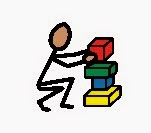
Model by using one or two words more than you child is currently using:When using an augmentative communication system to model language, not every word needs to be selected on the display or device as we are talking.  To teach our students how to take the next steps, we can keep adding to what we are saying. Start with one word and when we know that our student can manage that, add on another. Keep building language one step at a time. 

Use “think outloud” strategies: 
When selecting words on a display, it can help to talk through the process so that your child can follow along. We can share with our students the connections that we make that help us to remember where to find a specific word. Often these connections are made through life experience - our students maybe don't share these connections yet, but we can help them with some explanation as we search for words. "I want to ask for a big cookie, so let's see how I can say 'big'. I think maybe it's here - I see an elephant and he's really BIG. Let's see... yes, there it is: 'big'. I want big cookie!" 

How much is too much?
When modeling language, when do we immerse our students in language and when do we need to consider more focused modeling? Gail VanTatenhove has some suggestions around providing modeling for students who may have visual, auditory and /or motor processing challenges.

Practice, practice, practice… 
When you read the information, this whole process sounds kind of straightforward… we point to pictures as we talk. Which leads us to wondering why we are not necessarily seeing everyone modeling language on communication displays or devices when we walk into classrooms or clinics or homes… In reality, being able to model language for children using any form of AAC takes practice. We need to slow down and think about what we are saying. We need to know where all those symbols are located before we can show our students where they are. Sometimes, especially for a system with lots of vocabulary, this means that we need to spend some time learning where the messages are located ourselves. One way to do this is to make a paper-based copy of what’s on the student’s system.  That way, we can get to know the communication system better, without having to take it away from the student.

Some words of wisdom, as always, from Praactical AAC about "Getting the Team On Board". 

Start a modeling revolution…
Share the idea of modeling with family, colleagues, peers.. if everyone starts to point to symbols as they speak, perhaps others will follow along. Make some extra copies of the core board that is used in your classroom and throw on a sign that invites others to join in: “Welcome to our classroom. Grab a board and come talk with us!”


Want more?
There is so much information online about this topic... a great place to start is back at Praactical AAC, where there are many posts with related resources.


(Original Post April 1, 2015, Updated July 24, 2020)


Tuesday, 2 December 2014

I can...open the door to adulthood.


Our children grow up in the blink of an eye... before you know it they are going to high school and then it's only a few short years before they enter into the adult world. Skills needed to negotiate that adult world need to be introduced and practiced long before they will be used. Our students need lots of time (and help) to learn about how things change when you become an adult. This month we will consider some of the supports that we can put in place to help our students take on this challenge.

Keeping Communication Relevant - Reviewing and Updating Vocabulary- Personal communication displays and devices need frequent review to determine whether all the vocabulary required by an individual is available. When changes are made to vocabulary, we need to ensure that our students know where to find their new words. Our vocabulary needs change as we get older - often our students need help to learn new words ("What is a budget?", "I need to book an appointment.") and to find out how to use them appropriately. 
Consider including generic vocabulary for people and places:
  • 'support worker' vs. 'Julie'  (support teams sometimes change frequently)
  • adding 'person' if not already included on a display
  • 'someone else'

Remove immature vocabulary, and change language to better reflect the age of the person using the system.
  • "Yo!" to "Good afternoon"  

Expand topics to include those for self-advocacy and directing others.
  • directing personal care routines 
  • participating in meetings
  • maintaining communication device or writing system
  • changing or repairing seating
  • arranging and using transportation
  • discussing politics
  • organizing banking and finances
  • community-based events such as grocery shopping, eating out
  • safety and emergency situations
  • legal issues

Include young-adult/adult appropriate topics like:
  • death and bereavement
  • intimacy and sexuality

Here are a couple of great resources related to vocabulary around adult communication topics. 


Institute on Disabilities at Temple University  This website contains vocabulary (graphic symbols and icon sequences) needed to participate in 8 socially-valued adult roles: 


  • College Life 
  • Emergency Preparedness
  • Employment
  • Sexuality, Intimacy, and Sex
  • Reporting Crime and Abuse
  • Managing Personal Assistance Services
  • Managing Health Care, and
  • Using Transportation

Widgit Health provides a range of symbol-based information sheets to help facilitate clear communication in an emergency situation. 

What are soft skills, why does my teen/young adult need to learn them and how can I teach them? Visit the Special Learning blog to read about considerations for learning social skills needed in the workplace.

Community Connections

Talk with families who also have children who are transitioning into adulthood to find out what resources they are using. Your local children's treatment centre may have groups, supports or information that can be explored before your child leaves school. At TVCC in London, Youth Discovery Services offers workshops, drop-in conversations and resources, and individual consultation and coaching as needed. 
 
Hutton House in London, Ontario is an example of an organization that offers an array of activities and resources for people with disabilities moving into adulthood. Hutton House promotes and supports persons with disabilities through learning and life enhancing programs that focus on each individual's strengths, abilities and interests.

Teaching & Training others: 
Individuals who have complex communication needs may come into contact with many more people once they are adults. New environments bring new people into the picture. Appointments in the community also involve new people. It can be helpful to have some strategies in place for sharing information quickly and easily around communication strategies and personal preferences. 
 - Have photographs available to show others quickly how you like things done or set up (e.g. mounting of a speech generating device, location for charging device).
 - Use scripts to give directions to unfamiliar communication partners about how they can communicate with you.
- Look for apps that can be helpful in sharing information. Here's one that can be used to explain what's needed for a particular event or process. For example, you can create a short presentation on how to set up the mounting components for a speech generating device, focusing attention on the most important details.  Explain Everything Whiteboard app  is an easy-to-use design, screencasting, and interactive whiteboard tool that lets you annotate, animate, narrate, import, and export almost anything to and from almost anywhere.

It's a great idea to update a Communication Passport when high school is done. The Call Centre in Scotland has a template specifically for adults.  


Don't forget to add contact information to all of the pieces of your communication system. Being out in the community more often means there are lots more opportunities for things to get lost. 


Finding meaningful activities:

Hutton House promotes and supports persons with disabilities through learning and life enhancing programs that focus on each individual's strengths, abilities and interests. - See more at: http://www.huttonhouse.com/about-us#sthash.Ls38Xlpg.dpuf

AAC Leadership Course Communication Disabilities Access Canada (CDAC) offers this online course for adults over 18 years of age who use AAC. The course is designed to assist adults who use AAC to learn skills to support:
  • Other adults who use AAC
  • Clinicians working with children who use AAC and their families
  • Students in disability fields
  • Organizations to improve communication access to goods and services
The course contains lessons and assignments about:
  • Effective communication
  • Collaborative problem-solving
  • Disability services and resources
  • Communication rights
  • Participating on committees
  • Making presentations

Reach out and be inspired by those who have lead the way:


John Draper draws on his life experiences to help inspire accessible and inclusive communities.  He has won many awards recognizing his efforts to promote equality for all citizens through his presentations and resource development. John founded Together We Rock where they inspire learning and champion leadership to create accessible and inclusive communities.
 
Kevin is a university student, an author, and an athlete.  See his story  at I Am Able - Kevin Enners


Colin Philips is a young man who uses AAC.  He speaks about his experiences with transitioning into adulthood and realizing that he is gay. 

Check in with manufacturers for ideas and resources pertaining to adults.
Many of the companies that develop and produce AAC resources have information on their websites that is specific for certain age groups or topics. 


Saturday, 1 October 2011

I can...trick or treat!

 The month of October brings fall leaves, pumpkins and Hallowe'en.  We thought we would share some "tricks" for helping kids who use Augmentative Communication (AC) to learn the words and symbols they need.  The "treat" will be for them to be able to share their stories, thoughts and feelings with the people who are important in their lives.


Today's technology is truly astounding.  The Speech Generating Devices (SGDs) currently available to us have so many capabilities in addition to providing a voice for kids who need AC.  Devices have become more affordable and now many of them have that "cool factor". Software is more readily available and has become more user friendly, making it easier to produce communication displays that anyone would be proud to use.

Getting a new device or communication display is just the beginning of the story...kids who use AC still need to learn the words and symbols that are in their communication systems.

  • Many communication displays or devices come with pre-programmed vocabulary that is designed to be personalized for each child.  You need to decide which vocabulary items to teach first.  Often, this is goal driven and agreed upon by the child's team.  You can select vocabulary items based on the current classroom topic.  For example, in October the students may be talking about Hallowe'en or Fall. There are many specific words associated with these events such as "vampire", "pumpkins", and "witch".  While these words may be used for a short time, think about vocabulary that can be used in many different situations such as "scary", "dark", "look", "eat", "go".  These words are used more often in daily activities and may be more functional for the child. Here is some information about teaching children Core Words, the words that are used most frequently in daily language. http://ifonlyihadsuperpowers.blogspot.com/2009/04/therapy-thursday-language-based.html

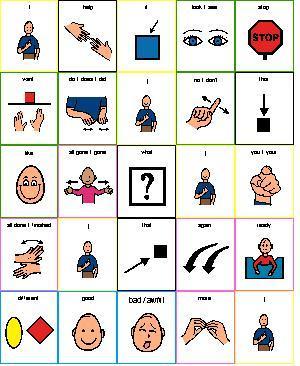
  • Top 30 Core Words (Information from work by Gail M. Van Tatenhove)
all done / finished
all gone / gone
bad
different
good
more
what
not / don’t
that
this
I / name
it
you / your
again
ready
do / does / did
help
look / see
stop
want
big
little
away
come
drink
eat
get
give
go
like

  • Once you've decided "witch" words you want to focus on, the trick is to make sure everyone knows! 
    • Post a list on the classroom wall where your child can easily see it.  Paste the corresponding symbol(s) on the list.  Be sure to become familiar with where these words are on your child's communication system.
    • Post a list at home where everyone can see.
    • Think of opportunities for your child to use these words many times throughout the day.
    • Model the words yourself in the classroom and at home to help reinforce the meaning.
  • Kids who are verbal, learn the meaning of a word by repeatedly hearing it used in context and by saying it.  Kids who use AC need the same opportunities to see how symbols can be used to convey meaning. 
    • You can use your child's communication system when you are speaking to show them where a word is located and how to use it functionally.  
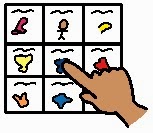
    • Point to the symbols representing the key words on your child's display or device.  You do not have to point to every word in your sentence to express your overall message.  A mini light pointer can also be used to "point" to the symbols.
    • Let your child know that you will be using his/her display.


Who Can Help?  If you want some extra support for teaching your child vocabulary, please contact your AC Clinician.

No Tech Solutions:  Try using the child's chosen vocabulary in word BINGO!  To reduce visual demands, try using colours/symbols in some boxes and the chosen vocabulary in other boxes.  See the example on the right.


Light Tech Solutions: Your child can use their simple SGD eg. Step by Step,  to practice using their chosen vocabulary in a variety of activities.  For example, take a walk around the school and let your child guide the way with pre-recorded messages such as "Let's go!" and "Stop!".

High Tech Solutions: Reinforce chosen vocabulary in writing activities either directly on your SGD or at a computer.  Check out this switch accessible book we've created using TarHeel Reader called "I like Fall"  that highlights some core words.  http://tarheelreader.org/2011/09/26/fall-14/6/  You can choose between 3 different voices for speech feedback options on the left hand side of the screen.  

I Can...be a Star!
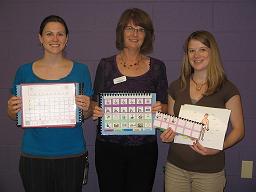
We'd like to recognize the use of communication displays within our Seating and Mobility Services (SAMS) at TVCC.  (Left to Right: Christie Beldom, Sue Kirkpatrick, Julie Denney).  If you would like more information about the communication displays that were developed for TVCC seating appointments, please contact Lisa Evans at lisa.evans@tvcc.on.ca

Feedback from Sue Kirkpatrick, Physiotherapist in SAMS:

"Using the communication boards has impacted my practice with my clients in many ways. I discovered that I was getting into a bit of a routine of saying hi to my ‘non verbal’ clients, acknowledging something about their lives then going into conversation with their parents. I would interact with the client but not delve too deeply into conversation with them. Using the communication boards has brought that to my attention and now I purposely engage with those clients over most of the appointment. The boards have provided a means to do this, as many clients do not bring their personal communication device to the appointment.

What I have discovered is that these kids have lots to say, of course. And they say stuff that I wasn’t expecting at all. For instance, one client let me know that he thought his mom was mad at him because he was falling forward a lot and couldn’t sit up straight anymore. Another client let me know that he was having pain…. And that wasn’t even on our radar.  It has given them a voice and let’s them know that I care about what they are thinking.

I had another absolutely amazing experience with a client has very limited movement and she uses a Kimba stroller for mobility. She uses fibre optic switches in custom hand molds that initially operated a switch toy. After it was known that she could access the switches consistently it was decided to try her on the Magic Carpet (a platform for power wheelchair training).   The Kimba was secured onto the Magic Carpet and the switches were set up for her. She was able to operate the platform and take it in the directions she wanted to go the first day. We knew it was purposeful movement because she drove it directly to a table. We thought she couldn't stop so we stopped her and pulled her back towards the center of the room. The client then promptly drove back to where she was before. On the table in front of her was the Communication Board. She wanted to tell us that she was hungry and wanted something to eat. It was the most amazing experience I have had in a very long time. It brought tears to my eyes."

Feedback from Julie Denney, Occupational Therapist in SAMS:

"Using the communication boards to interact with my seating clients has definitely been a learning curve for me, however, I have had some great experiences so far with a few of my clients to learn more about their seating issues and other things they have wanted to say.  I had a client state that his footrest needed some changes.  Mom did not express this issue as she had forgotten about it.  I also had a client who told me she went to see a movie with her dad.

My experience with the communication boards has motivated me to interact with my non-verbal clients more and improve my use with the communication boards as these clients may have thoughts of their own that they would like to express, but don’t always get the chance to do so."

Don't Miss It!
Can't make it to a conference or educational event?  Look for a webinar online.  Check out some of Bridges Canada's webinars: http://www.bridges-canada.com/eventswebinars.aspx

Resources:
Extension activites ideas are often readily available on manufacturer websites

Sunday, 1 February 2009

I can... find the words


Choosing vocabulary for an individual’s communication display can be challenging. There are so many words to choose from – which ones do you add? What do you do if the word that you want isn’t on your display? A student’s communication display needs to be personal and as unique as the individual who uses it. Here are some things to think about when developing a display.

 Some vocabulary suggestions for an introductory core display:

I, (name)
look / see
want
again
different
you / your
do / does / did
this
more
good
it
help
that
all gone
bad
not / don’t
stop
what
ready
all done/finished
 

Core Vocabulary

Caregivers, educators and therapists frequently spend lots of time creating topic-specific communication boards for students, to encourage active participation. The cooking board is brought out when we bake (“stir”, “taste”, “yummy!”), the music board presented for singing (“louder”, “again”, “cymbals”) and the reading board made available at library (“book”, “check-out”, “change”). Use of communication boards that change with each activity limits opportunities for students to learn and locate words. While these boards meet a specific need at a specific time, they may not allow for communication outside of those activities.
Individuals also need a personal AAC system that includes a core vocabulary. The idea behind core vocabulary is to focus on a small number of common, high frequency, re-usable words that are organized so that the student can access them as easily as possible. These words can be used for many reasons: to greet, request, reject, direct, etc. The students need to be taught the location and meaning of the words, and how to use them.


Of course there will be times when extended vocabulary (often referred to as “fringe vocabulary”) will be needed. This can be included with the main display, for example using flip sheets. “Flip 'n Talk” is one convenient way to display core and fringe vocabulary. 

The same principles should be considered when using vocabulary for adapted writing activities (e.g. on-screen keyboards).  If you would like further information around core vocabulary for a child who is currently on the TVCC-ACS caseload, please do not hesitate to contact your ACS clinician(s).

No-Tech Ideas


  • When adding symbol labels within the classroom or home, think about using words that encourage kids not just to label items (“door”, “coat”, “arts ‘n crafts”), but also to talk about them (“Go out”, “Put it up”, “I make pictures”).
  • Make a large wall-mounted copy of a person’s low-tech board so that others can become familiar with the word locations (helpful when modeling use of vocab.).

Light Tech Ideas


Add a message that allows an individual to request their low-tech communication book / display. “I need my communication binder. Please place it on my tray.”

High Tech Ideas


Most higher-tech Speech Generating Devices with customizable vocabularies are shipped with a vocabulary index that lists the words and their locations on the device. This helps to avoid programming a word into a second location, which can be confusing for the person using the device and the facilitator. Put the index in a convenient location for easy reference. Check the manufacturer’s website to see what’s available. 

Libraries for All 
Did you know that a variety of communication boards are available at all London Libraries? Request the use of a board at any library help desk. More info at www.tvcc.on.ca.
On-line Resources: Check out these websites for great ideas…

Narrative Development through Story Re-Telling: Story telling is a great activity to practice using core vocabulary. 

Aided Language Stimulation and the Descriptive Teaching Model describes strategies for teaching individuals to use AAC.