Showing posts with label all about me. Show all posts

Tuesday, 8 September 2020

I Can....Create a Communication Passport

Being well prepared for any situation can make all the difference for a successful outcome.  This is often the case when we think about providing positive communication support for people who use AAC.  When we know what will help an individual to get their message across successfully, both communication partners feel more comfortable and messages are given and received more easily.  This month we are featuring information about Communication Passports: a great way to share information about a person's communication profile. 

What is it?

A Communication Passport is a visually interesting and informative book (or booklet, flyer, place mat, etc.) that highlights information about a person's personality, likes & dislikes, communication strengths and needs. It is a way of presenting information that can be crucial in supporting successful interactions between a person who has difficulty communicating and their communication partners. 

A Communication Passport is one of the communication tools that is described in the You Tube video entitled "Knowing Me: Communication Tools for Transition".

Why is it important? 

Children and adults who have complex communication needs may express themselves in a wide variety of ways, not necessarily using speech or other more conventional methods of communication.  Some of our students use very specific methods to communicate, perhaps including some subtle body movements or gestures that might be easily missed when you don't know quite what you are looking for. A Communication Passport can help you get to know exactly how a person communicates and how you can help.

Who is it for? 

A Communication Passport is intended to get the basics about how best to support a person's communication to those who need it. 
Anyone who is new in your student's life: a substitute teacher, a new educational assistant, respite workers, summer camp counselors. These people often have limited time to get to know an individual who uses AAC. A Communication Passport can help them to understand the basics that might make interactions more successful. Highlight the most important pages in the passport that you want these people to read.


People you meet infrequently: doctors, dentists, hairdressers, the specialist who is coming to complete an assessment. Sharing information with these people quickly and easily may help to make these "special events" in a person's life more positive and successful.


Peers, classmates: sharing information that can promote positive communication experiences with peers is so important for our students. 


Extended family members: grandparents, aunts, uncles and cousins who do not have  a lot of experience with interacting with someone who uses an alternative form of communication may benefit from the additional information that is captured in these documents. It can serve as a reminder when grandparents come to baby-sit. Or as a way to introduce a few tips to make communication more successful during a family occasion.


Where to keep it:

If you put in the effort to make a communication passport, you want people to read it. You want to make sure that it is visible and handy for everyone to read when they have a few minutes to do so. Keep a communication book where it is needed - hang it on the back of a wheelchair where others can see it. Make the cover interesting and add a message that invites others to look inside. Think about letting others know that the book is new and invite them to come and take a look. 

Consider the content of what's contained inside the book. Whenever possible, involve the person you are making the book for, so that he or she knows what is included and is happy to share that information with others. Keep privacy issues in mind when sharing information about personal needs or any topics of a sensitive nature.


Make it personal:

Let's be honest, reading a report about someone's communication abilities and needs can be pretty dull, no matter how important the information contained within it.   A Communication Passport is not a formal document.  It should scream "Read Me!". People who notice it hanging off the back of a chair should be intrigues and curious and itching to open the cover.  You can show some of the individual's personality throughout this book. Create a funky cover, add photographs and quotes. Make it something to be proud of and something that others really want to read.


 How do I make one?  
Step by step instructions for making Personal Communication Passports can be found on the CALL Scotland website. Here you will find templates (including variations such as Mini Passports), good practice guidelines for creating the document (including a checklist to evaluate the outcome of creating the passport) and tips and information that will be helpful as you work your way through the process. There is a great collection of articles that can be downloaded. "Introduction to Passports" by Sally Millar makes a great handout to share with others, detailing what a passport is all about. 

Who can help me make a passport? 

There is a lot of information online that will help you to create a passport for your child or family member. If you need some support, a Speech and Language Pathologist may be able to work with you. Sometimes you may find that someone in your child's class can lend a hand - this may be something that a DSW student can work on during a placement at the school. Not only will it allow that person to get to know your child, but may give them an opportunity to learn about a resource that may be helpful to them throughout their career. Think about involving your child's siblings or peers when pulling the information together to put into a passport. Sometimes peers look at things differently and they may have interesting insights about what's important to your child.

Updating: 
People change and passports need to change too, to reflect what's different. This is one good reason to keep a passport simple and to keep a back up copy that can be edited easily. Think about  a way of putting your passport together that will allow you to change a single page at a time, rather than changing a whole book. Give yourself a deadline for updating the book each year, perhaps before school starts up again in September.


Passports for different reasons:


Emergency situations call for very specific information that can be found and used quickly and efficiently. This is not the time to be reading through a book of personal details, it is a time for the basics in an instant. 
Here's a description of the Communication Passport for A&E resource from Praactical AAC:
"This Communication Passport is designed to give important information about a person who uses AAC to healthcare professionals and first responders in case of accident or emergency. It uses a stoplight metaphor to guide the partner through important information, such as emergency contacts, health conditions, medications, how the person takes their medication, how to communicate with the person, and more."

The template is free to download. 

My Health Passport - This passport has important information that allows health professionals to best support someone with complex communication needs while they are visiting a hospital or clinic. 

Page Profiles are documents that summarize the supports that a person needs in order to participate to their full potential. Again, a quick and easy way to share information that might just make an experience successful. Typically, one page profiles contain 3 sections:

  1. ‘Appreciation’ – what people appreciate about the person, their character, gifts and talents
  2. ‘What is important to’ – what matters to them, from their perspective, about school and life
  3. ‘How to support’ – the ‘expertise’ from family, teachers and others about how to get the best out of the person
Examples of One Page Profiles and templates are included here. There are also links to other resources, including You Tube videos of what to consider when creating a one page profile.


Keeping it simple

A Communication Passport does not have to be printed in colour, laminated and bound professionally. While we often want the finished product to be something that the user can be proud of, there are situations where sharing the information any way that we can is the most important thing. Here's an example of a project in Ghana , where Communication Passports were made with paper, pen and glue. 


(Originally published on May 12, 2015 and updated December 2020)

Wednesday, 7 January 2015

I can ... get things moving!

In our busy world, it often feels like we are moving at the speed of a race car from one thing to the next. Once in a while we may need to slow down or even to stop, while we are waiting for something to happen: an appointment, an assessment or a meeting that will lead us to our next steps...
While we are waiting, there are often things that we can do to keep everything moving along and to get prepared for what lies ahead. In the world of AAC, here are a few suggestions of ways that we can keep taking those steps forward.


What can I do now?

When you have to wait for an assessment or for AAC services to "begin" for your child, ask your service provider about what you can be doing to get ready. There are a variety of service pathways at the children's treatment centres across Ontario. Often the process is outlined on the Centres' websites. 

At TVCC in London, Ontario, parents and caregivers of children who have been referred are encouraged to complete an Augmentative Communication Orientation online learning module, where they learn about what's involved in the assessment process. Families may also participate in a Discovery Consultation at which information related to their child's existing communication skills is shared. If their child then needs to wait for an assessment, suggestions are made for some introductory "next steps" that can help that child continue to develop their communication skills while waiting for an appointment.

Gathering information...
You may be asked to gather together information that will ultimately be used when service providers are beginning their involvement. Some of this information can be helpful in many different situations: informing a new teacher about how your child communicates, sharing information with a support worker in the home, providing an update to a medical specialist at your next appointment. 

Here are a few ways to pull all of that information together:

 - Observe your child and document what you see. Your child will have lots of different ways that they use right now to let you know how they're feeling or what they want to do. If you can list what your child does and what it means, it can be very helpful to others who are just getting to know them for the first time. Sometimes this list of communication strategies used is referred to as a "Communication Dictionary". 

- List your child's preferences e.g. favourite toys, books, movies, activities. When thinking about setting up opportunities for practicing communication, AAC clinicians will often want to engage your child in activities that are highly motivating. Knowing what items your child doesn't like can be equally important, as there are times when we need to know if a child is making a request for an item with intent ("I'm looking at my favorite stuffy. I really want it.") vs. looking at an item because you have held it up ("I'm looking at the empty kleenex box"). 

- Considering your child's preferences is a great starting point for documenting vocabulary that you think will need to be added to any communication system that is put in place. Start to keep a note of those key words that will be motivating for your child - the names of pets or best buddies, places that they love to visit, expressions that your family likes to use. The list that you generate can later be used as a starting point for customizing a vocabulary on a speech generating device or personal communication display.

Thinking about funding...
When looking ahead to putting in place communication strategies, there may be items that are recommended to be purchased or leased following the assessment. Many funding sources require documentation from a doctor stating a child's diagnosis. It will be helpful to obtain this from your doctor ahead of time. Information about potential funding sources is often available through a local children's treatment centre. In London, Ontario, TVCC funding information can be found here.  

Sharing Information...
- Put your observations into an "About Me Book". You can make it as fancy or as straightforward as you want. Sharing information about how your child communicates can provide the context needed for successful communication. It can also be used to share interests and spark conversation. 

- Another way of collecting all of this information is by creating a "Communication Passport". Download a template that can be customized and printed out. 

- Create a "Remnant Book". This is a place to store photos, postcards, tickets or mementos that are meaningful  to someone. This provides a way to talk about things that are fun or important to the person and allows others to get to know them better. Many families use a small photo album that can be easily transported or attached to a wheelchair with a clip. 

A picture is worth a thousand words...
Capture some examples of how your child is currently communicating on a phone or tablet. This can be a very helpful tool when introducing your child to new people. Not only does it show what your child is capable of, it can also show new communication partners how they can best interact with your child (e.g. how to ask questions, how to interpret responses). These days you can gather all your information together in a high tech manner - capture the information for your communication passport in a Prezi that others can watch and learn from. Here's a brilliant example, all about Abby


Shape your child's yes and no responses. Having a consistent, repeatable and recognizable way to say "yes" and "no" can be very helpful when your child is communicating with a variety of different people. There are lots of ways that you can say "yes" and "no" - a head movement, a gesture, moving your eyes a certain way, etc. In addition, we sometimes use different methods at different times to 'say' these words. Our students often benefit from clear feedback about what they have done that has been accepted as a "yes" or "no" response: "I see you looking right at me - I think you are telling me yes". Share with others what has worked and what you are looking for as a "yes" and "no" response - make sure it's listed in your communication dictionary and passport!
For additional ideas for shaping yes/no responses, check the Teaching Learners with Multiple Needs blogspot. 

Modeling...
Here's something that you can start doing as soon as symbols are introduced for your child.  Pointing to symbols as you speak helps kids understand what symbols mean and how they can be used.  It sounds like a simple enough idea, but requires us to change how we interact with our children.  The PRC Let's Talk Blog has a wonderful post by Beth Ahmad that explains why we need a "Model, Model, Model" Mantra. 

Learning locally...
Often Children's Treatment Centres will offer workshops and small group activities for children, parents, siblings and caregivers. Information about what is available may be posted on the Centres' websites or may be available from other professionals who work with your child. At TVCC in London, Ontario, online Education Workshops on specific topics are available.  If you don't see the workshop that you think will be most helpful for you, let your clinicians know. Sometimes workshops are developed based on how many people are asking for them.


Wednesday, 1 October 2008

I can... get to know you!

Since starting back to school in early September, your students have likely had several opportunities to meet new people: teachers, classmates, support personnel, even a new bus driver.  Meeting new people can be challenging, particularly for students who use Augmentative and Alternative Communication (AAC). Here are some ideas to make this a less stressful process.


Here are some vocabulary suggestions for getting to know new people:

Great to meet you!
Let’s trade e-mail addresses.
What’s your name?
There are some things you need to know about how I communicate…
I’d like to remember your name. Can you help me add it to my device?
I need to compose my message. It will take a few minutes – can you wait?
Tell me something about yourself.
Check out my “All About Me Book”, it’s in my backpack.
I don’t think we’ve met. My name is …
Do you have time to talk?
Please get my symbol display.
How are you doing today?

Communication Passports or All About Me books

Communication passports are books that present an overall picture of a person. They are written in a way which reflects the person’s personality and can include the following:

  • general background information including details about likes & dislikes, family and friends;
  • a description of how the person communicates and how others can best communicate with them;
  • a summary of the person’s views and preferences.
Communication passports are best created in partnership with the person who will “own” the  finished product. They need to be unique and engaging to others. These resources are particularly useful at times of transition, for example when a student moves from elementary school to high school. 

No-Tech Ideas


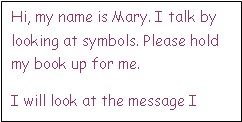
·         People can be nervous about talking to an individual who uses AAC. Help your student create a personal introduction to their communication system. Write a short paragraph about how the system is used and how the student wants the listener to help. Post it in a place, where all listeners will notice it & read it, for example on a tray or a wheelchair.

Light Tech Ideas

·         Ablenet carries a range of introductory devices that work well for students who want to share information or news. The good news is that they have recently improved some of the devices, such as the Step-by-StepTM, which now has 2 full minutes of recording time, better digital sound and improved battery life. Makes a great Christmas gift!

 High Tech Ideas

·         Some devices have Internet, email and messaging capabilities. Chat with your ACS clinician to find out more about this.

·         Remember your Internet safety tips
http://safecanada.ca/parents_e.asp?OP=link&topic=239

Resources for families and educators: Check out the following websites for great ideas…


· Read more information about the 2007 ICE conference (See “Opportunities to Learn”): http://www.marchofdimes.ca/dimes/people_with_disabilities_caregivers/news_and_ media/omod_news/2007/ICE2007.htm

Friday, 1 February 2008

I can...go out and about!

Exploring the community is fun for everyone. Try planning a field trip and encourage your students to participate in the preparation as well as the event itself. Students can also share their adventures by taking pictures and talking about them in a variety of ways.

Here are some vocabulary ideas for your student to use while out in the community:
Are we there yet?
I need to go to….
Are we taking the bus?
Where are we going?
Can you guess where I went today?
I need to call a taxi
I’d like to order a…
Do we have to go home already?
Let’s take a picture
That’s amazing!
It’s your turn to choose where we’ll eat
Watch out for the….
I’m lost!
Can you help me pack my bag?
I need some water
Here are some suggestions for making your trip out in the community a success:

  • Role Play - Talking about an upcoming trip with your students can help them prepare for the different places they will visit and people they might meet.  For example, if planning a trip to the mall, be sure to make a list of items you are looking for.  Try role-playing to give students a chance to use some of the phrases they might use while on their trip.
  • Educating Others – When taking your students out to a new place, call ahead to find out when there may be a quieter time so that students who use Augmentative Communication can be more successful in their communication. Share information with people in the community on how best to communicate with someone who uses Augmentative Communication.   
  • Review vocabulary on your student’s device or communication display – Brainstorm the situations in which the student may want to communicate.  Try using the vocabulary available and then add additional vocabulary that might be needed. For example, in a trip to the bowling alley a student may want to say “Strike!”, “Spare!”, “Gutter ball!”.
  •  Sharing the experience – Try to provide your students with the opportunity to tell others about their recent field trip.  Be sure to include some questions for the listener to help draw them into in the conversation.  For example, after a trip to the zoo a student may ask someone “What’s your favourite animal?”

No-Tech Ideas  

  • Take digital photos so that students can share their experience. 
  • Remnant Book – collect souvenir items such as a coaster, a movie ticket, a flyer etc and display in a small photo album. Students can then share information about where they have been visiting.

Light Tech Ideas
  • Try choosing a student to act as a “reporter”. Record the events on a Step by Step™ and ask the student to report the field trip highlights.
High Tech Ideas
  • Use digital pictures to create an electronic book. Try using Powerpoint™, Intellitools or Clicker to display the pictures. These books can be set up for switch accessibility.