Tuesday, 8 September 2020

I Can....Create a Communication Passport

Being well prepared for any situation can make all the difference for a successful outcome.  This is often the case when we think about providing positive communication support for people who use AAC.  When we know what will help an individual to get their message across successfully, both communication partners feel more comfortable and messages are given and received more easily.  This month we are featuring information about Communication Passports: a great way to share information about a person's communication profile. 

What is it?

A Communication Passport is a visually interesting and informative book (or booklet, flyer, place mat, etc.) that highlights information about a person's personality, likes & dislikes, communication strengths and needs. It is a way of presenting information that can be crucial in supporting successful interactions between a person who has difficulty communicating and their communication partners. 

A Communication Passport is one of the communication tools that is described in the You Tube video entitled "Knowing Me: Communication Tools for Transition".

Why is it important? 

Children and adults who have complex communication needs may express themselves in a wide variety of ways, not necessarily using speech or other more conventional methods of communication.  Some of our students use very specific methods to communicate, perhaps including some subtle body movements or gestures that might be easily missed when you don't know quite what you are looking for. A Communication Passport can help you get to know exactly how a person communicates and how you can help.

Who is it for? 

A Communication Passport is intended to get the basics about how best to support a person's communication to those who need it. 
Anyone who is new in your student's life: a substitute teacher, a new educational assistant, respite workers, summer camp counselors. These people often have limited time to get to know an individual who uses AAC. A Communication Passport can help them to understand the basics that might make interactions more successful. Highlight the most important pages in the passport that you want these people to read.


People you meet infrequently: doctors, dentists, hairdressers, the specialist who is coming to complete an assessment. Sharing information with these people quickly and easily may help to make these "special events" in a person's life more positive and successful.


Peers, classmates: sharing information that can promote positive communication experiences with peers is so important for our students. 



Extended family members: grandparents, aunts, uncles and cousins who do not have  a lot of experience with interacting with someone who uses an alternative form of communication may benefit from the additional information that is captured in these documents. It can serve as a reminder when grandparents come to baby-sit. Or as a way to introduce a few tips to make communication more successful during a family occasion.


Where to keep it:

If you put in the effort to make a communication passport, you want people to read it. You want to make sure that it is visible and handy for everyone to read when they have a few minutes to do so. Keep a communication book where it is needed - hang it on the back of a wheelchair where others can see it. Make the cover interesting and add a message that invites others to look inside. Think about letting others know that the book is new and invite them to come and take a look. 

Consider the content of what's contained inside the book. Whenever possible, involve the person you are making the book for, so that he or she knows what is included and is happy to share that information with others. Keep privacy issues in mind when sharing information about personal needs or any topics of a sensitive nature.


Make it personal:

Let's be honest, reading a report about someone's communication abilities and needs can be pretty dull, no matter how important the information contained within it.   A Communication Passport is not a formal document.  It should scream "Read Me!". People who notice it hanging off the back of a chair should be intrigues and curious and itching to open the cover.  You can show some of the individual's personality throughout this book. Create a funky cover, add photographs and quotes. Make it something to be proud of and something that others really want to read.



 How do I make one?  
Step by step instructions for making Personal Communication Passports can be found on the CALL Scotland website. Here you will find templates (including variations such as Mini Passports), good practice guidelines for creating the document (including a checklist to evaluate the outcome of creating the passport) and tips and information that will be helpful as you work your way through the process. There is a great collection of articles that can be downloaded. "Introduction to Passports" by Sally Millar makes a great handout to share with others, detailing what a passport is all about. 

Who can help me make a passport? 

There is a lot of information online that will help you to create a passport for your child or family member. If you need some support, a Speech and Language Pathologist may be able to work with you. Sometimes you may find that someone in your child's class can lend a hand - this may be something that a DSW student can work on during a placement at the school. Not only will it allow that person to get to know your child, but may give them an opportunity to learn about a resource that may be helpful to them throughout their career. Think about involving your child's siblings or peers when pulling the information together to put into a passport. Sometimes peers look at things differently and they may have interesting insights about what's important to your child.

Updating: 
People change and passports need to change too, to reflect what's different. This is one good reason to keep a passport simple and to keep a back up copy that can be edited easily. Think about  a way of putting your passport together that will allow you to change a single page at a time, rather than changing a whole book. Give yourself a deadline for updating the book each year, perhaps before school starts up again in September.


Passports for different reasons:


Emergency situations call for very specific information that can be found and used quickly and efficiently. This is not the time to be reading through a book of personal details, it is a time for the basics in an instant. 
Here's a description of the Communication Passport for A&E resource from Praactical AAC:
"This Communication Passport is designed to give important information about a person who uses AAC to healthcare professionals and first responders in case of accident or emergency. It uses a stoplight metaphor to guide the partner through important information, such as emergency contacts, health conditions, medications, how the person takes their medication, how to communicate with the person, and more."

The template is free to download. 

My Health Passport - This passport has important information that allows health professionals to best support someone with complex communication needs while they are visiting a hospital or clinic. 

Page Profiles are documents that summarize the supports that a person needs in order to participate to their full potential. Again, a quick and easy way to share information that might just make an experience successful. Typically, one page profiles contain 3 sections:

  1. ‘Appreciation’ – what people appreciate about the person, their character, gifts and talents
  2. ‘What is important to’ – what matters to them, from their perspective, about school and life
  3. ‘How to support’ – the ‘expertise’ from family, teachers and others about how to get the best out of the person
Examples of One Page Profiles and templates are included here. There are also links to other resources, including You Tube videos of what to consider when creating a one page profile.


Keeping it simple

A Communication Passport does not have to be printed in colour, laminated and bound professionally. While we often want the finished product to be something that the user can be proud of, there are situations where sharing the information any way that we can is the most important thing. Here's an example of a project in Ghana , where Communication Passports were made with paper, pen and glue. 


(Originally published on May 12, 2015 and updated December 2020)

Friday, 24 July 2020

I Can...use symbols so that my child will too!


We start talking to our children the day they are born, even though we know that we are not going to hear a “word” back from them for some time to come.  Research suggests that the average 18 month old has been exposed to over 4,380 hours of oral language – about 8 hours each day. Jane Korsten (Speech Language Pathologist) did the math to demonstrate that if we only provide speech and language therapy sessions two times per week for a child who has a communication system, it will take 84 years to reach the same amount of language exposure. If we are going to successfully teach a child how to use symbols, we are going to need to do a little more than that weekly therapy. Luckily, there are lots of things that we can do to help support a child’s communication development.


Our children who are using AAC need to see their language “in action”. Having others use the same AAC system to communicate allows our students to make connections between symbols and their meanings; shows them how to find symbols; how to put words together to make sentences; how to add word endings … They need to see it happen in order to do it themselves. On the flip side, modeling use of an AAC system also gives us a little bit of insight into what it takes to learn and use a system effectively. The only way to become proficient in using a personal communication display or speech generating device is to use it.


For an introduction to the technique of Aided Language, take 5 minutes to watch this video from One Kids Place Children’s Treatment Centre in North Bay Ontario.


"Modeling”, “Aided Language Input”, “Aided Language Stimulation”, call it what you will. On the wonderful Uncommon Sense Blog, you can find a great explanation of what is meant by these terms, along with links to some helpful related resources. (Honestly this blog is fantastic – the content that we wanted for our blog this month has already been created by Dana and beautifully put together!).
 

Check out the handout from the AAC Institute that can be printed out for your child’s team to share the message about modeling.

So, do you want to see all this in action? Again, Dana has done all the work for us by collecting some videos together showing Aided Language Stimulation happening across a number of different situations.


The Hanen Centre is a Canadian not-for-profit charitable organization committed to supporting parents, early childhood educators and speech-language pathologists in their efforts to promote the best possible language, social and literacy skills in young children. As clinicians we frequently talk to caregivers about applying some basic "Hanen" principles when working on communication skills. The information and suggestions found on this website apply to all children who are developing communication skills. Check out the Tips for Parents section on the website for some great suggestions on how to foster communication skills in everyday activities. Here are some things to keep in mind to turn that "work" that you are doing into "play".

First things first: make it fun!
Communication opportunities happen all around us, throughout the day. Children learn best when they are motivated and having fun – don’t we all? Any play activity is a chance to show your child how language can be used for a purpose.  Identify your child’s preferences in order to motivate him to use his communication skills in an activity.

“Look! My car. My car go up! Your turn. Car go up! Down, down, down. Car go down”. 

There is lots more information to be found on the Hanen website that you can use to find out "What Makes Your Child Tick?". 

Follow your child’s lead: 
As adults we sometimes like to have a plan. As parents or teachers or communication partners, we know that sometimes we have to throw that plan away and follow where our child might take us. Perhaps we thought we were going to play cars this afternoon, but if my child is fascinated with the bubbles in the washing up bowl, maybe we’ll talk about those instead. “Bubbles! I see bubbles! More bubbles! Bubbles go up.” 

Observe, Wait & Listen: 
Another key consideration from Hanen is to Observe, Wait and Listen (OWL). Here is their description of how this benefits a child engaged in playing with playdough:

Observe – your child and see what she does.  Observe silently, really watching to see what she is doing with the playdough. Often, children don’t begin with an idea of what to do with the playdough. They manipulate it and when it starts to look like something they recognize, they may then start to turn it into something specific. To give your child time to come up with her own ideas, just observe without speaking, suggesting or instructing her.
Wait – sit quietly and avoid showing your child things she could do with the playdough. Just squeeze or roll your own playdough slowly. Your goal is to give your child an opportunity to do what SHE wants to do FIRST.
Listen – to what she says, without interrupting. If she says something, respond and show interest, but avoid telling her what to do or try not to ask questions that test, such as “What are you doing?”, or “What are you making?” She probably doesn’t know yet - she’s still experimenting! 

Talk using simple repetitive language:
Model slowly so that your student can see which vocabulary items you are pointing to and can follow along. Carol Goossens recommends the following guidelines when providing aided language stimulation for children:
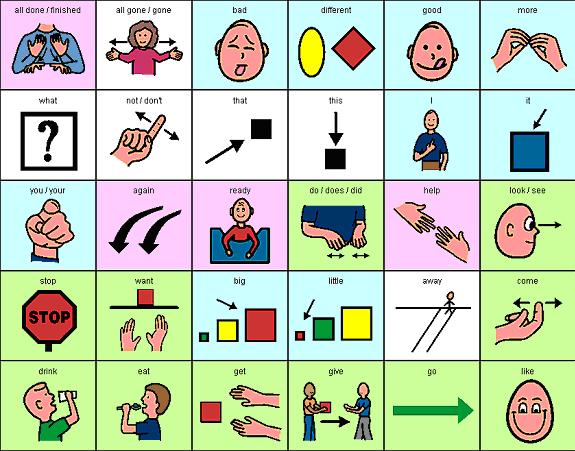
  •  use primarily single words (symbols) and short grammatically correct phrases (symbol phrases) to talk about what the child is hearing, seeing, doing and feeling
  • use lots of repetition as you describe ongoing events (lots of opportunities to practice)
  • speak slowly, inserting numerous pauses into the conversational flow
  • whenever the child indicates something with a single word (symbol), expand that message into a semantically equivalent two-word (symbol) combination.
Model by using one or two words more than you child is currently using:When using an augmentative communication system to model language, not every word needs to be selected on the display or device as we are talking.  To teach our students how to take the next steps, we can keep adding to what we are saying. Start with one word and when we know that our student can manage that, add on another. Keep building language one step at a time. 

Use “think outloud” strategies: 
When selecting words on a display, it can help to talk through the process so that your child can follow along. We can share with our students the connections that we make that help us to remember where to find a specific word. Often these connections are made through life experience - our students maybe don't share these connections yet, but we can help them with some explanation as we search for words. "I want to ask for a big cookie, so let's see how I can say 'big'. I think maybe it's here - I see an elephant and he's really BIG. Let's see... yes, there it is: 'big'. I want big cookie!" 

How much is too much?
When modeling language, when do we immerse our students in language and when do we need to consider more focused modeling? Gail VanTatenhove has some suggestions around providing modeling for students who may have visual, auditory and /or motor processing challenges.

Practice, practice, practice… 
When you read the information, this whole process sounds kind of straightforward… we point to pictures as we talk. Which leads us to wondering why we are not necessarily seeing everyone modeling language on communication displays or devices when we walk into classrooms or clinics or homes… In reality, being able to model language for children using any form of AAC takes practice. We need to slow down and think about what we are saying. We need to know where all those symbols are located before we can show our students where they are. Sometimes, especially for a system with lots of vocabulary, this means that we need to spend some time learning where the messages are located ourselves. One way to do this is to make a paper-based copy of what’s on the student’s system.  That way, we can get to know the communication system better, without having to take it away from the student.

Some words of wisdom, as always, from Praactical AAC about "Getting the Team On Board". 

Start a modeling revolution…
Share the idea of modeling with family, colleagues, peers.. if everyone starts to point to symbols as they speak, perhaps others will follow along. Make some extra copies of the core board that is used in your classroom and throw on a sign that invites others to join in: “Welcome to our classroom. Grab a board and come talk with us!”


Want more?
There is so much information online about this topic... a great place to start is back at Praactical AAC, where there are many posts with related resources.


(Original Post April 1, 2015, Updated July 24, 2020)


Friday, 30 September 2016

I can...say Goodbye

The I Can Newsletter was first published in May 2007, with an issue related to playing board games. This was in response to a request for ideas to be used in a classroom. Since then, we have covered dozens of topics, including going on a road trip, using social media, talking about math and using switches. We have tried to include resources that we've found helpful in our own practice. In the early days, I Can was sent out via email blast and evolved over time to the blog you see today. Along the way, we've learned lots about blogging and have had fun exploring topics that we think might interest our clients, their families and their school teams. We have now decided that the blog has run its course and that this will be the final I Can post. 

We hope that you will still look back through the archived issues of the blog, to find answers to some of your questions, websites of interest and just to get some ideas for using AAC in everyday activities.The Blog Archive sits along the left side of the blog and has a search function at the very top so you can look up blogs on a specific topic quite easily! 


We will leave you with some of our favourite websites, blogs and resources that we go back to time and again.  Thank you for following our blog and remember, You Can.....be a difference-maker for your children who use AAC!


Image result Something to watch out for!
"Speechless" is the new TV comedy about Maya DiMeo (Minnie Driver), a mother who is willing to do anything for her family. Her son, JJ (Micah Fowler) has cerebral palsy and uses augmentative strategies for communication. Maya will fight for justice in order to give her son what he deserves. It's on at 8:30 on Wednesday nights on ABC. 


Tar Heel Reader is a collection of free, easy-to-read, and accessible books on a wide range
of topics. Each book can be speech enabled and accessed using multiple access methods including touch screens, an IntelliKeys with custom overlays, and 1 to 3 switches. You may write your own books using pictures from the huge collection at Flickr or pictures you upload and you can publish to the Tar Heel Reader site once they're finished so that others can enjoy your book!!!

Some new ideas every day!

Praactical AAC never fails to deliver on sharing information that is truly practical and helpful for families, educators and clinicians.  

Jane Farrell is a leader in the field of AAC and has lots of experience to pull from.  She also has an amazing blog where she shares her ideas and suggestions for supporting literacy, AAC and other Assistive Technology


Uncommon Sense is Dana Nieder's honest and humorous blog where she talks about her family's journey with communication, AAC and different things they've tried with their daughter Maya who uses AAC.  It's always a great read and has LOTS of great resources!


And you can't forget SET BC! 
SET BC maintains searchable databases of resources that are created and updated by dedicated professionals working with students who use assistive technology in British Columbia, Canada.  
CurriculumSET is a searchable database where you can find, download, and customize activities, templates and public domain accessible books based on the curriculum as set out by the British Columbia Ministry of Education.  
PictureSET is a collection of downloadable visual supports that can be used by students for both receptive and expressive communication in the classroom, at home, and in the community.  It allows you to find a wide range of visual supports for curriculum areas, activities, and events. 

AAC Intervention
Here you'll find years and years worth of "Tips of the Month'' with free practical suggestions for teaching & learning AAC strategies, writing using alternative tools, literacy development, participation and the list goes on and on!!!  They also have resources that you can purchase for more in depth information.  The Links section takes you to lots of other fabulous expert resources that are great to have in your communication toolbox!  


VocaliD - be a voice donor!!!

Over ten million people rely on text-to-speech devices that use synthesized speech to express themselves. There is a limited pool of voices available, so whether they are young or old, male or female, shy or outgoing — they all speak with similar voices. VocaliD is a voice company that is using voice blending technology to create unique vocal persona for any device that turns text into speech. 14,000 speakers from over 110 countries have already contributed over 6 million sentences to their growing spoken repository but in order to continue to create these unique voices, they need more!!! Please, visit the VocaliD site to learn more about how you can add to this voice bank from the comfort of your own home!


Something to inspire!  
Watch "Talk to me" -  a short video where Pheobe helps to raise awareness of living with a disability and using AAC.   

Tuesday, 31 May 2016

I Can...say thank you!


As the Dalai Lama XIV (and many other people of wisdom) once said, nobody is too small to make a difference!  We'd like to acknowledge some of the small but mighty teams and individuals who make a difference in the lives of our students. 

It is the dedication and commitment of these families, educators, and community members that lays the foundation for successful AAC use. We asked TVCC ACS clinicians to share some of the success stories that they see every day (there are so many that could be shared!) and these are some that stood out for them! 

First, let's meet Kasey....   
Kasey received his device in the summer of 2015.  He has made some HUGE gains since then! Each time his ACS team members see Kasey, they are blown away at how well he's learned his complex communication system.

Kasey attends Senior Kindergarten at Caradoc Public School in Mount Brydges.  With the help of his school team and parents, Kasey continues to grow his vocabulary and learn how his words are organized.  He has had alot of change in terms of school staff who support him but this hasn't impeded his ability to learn how to communicate with his device!  His school supports have been encouraging Kasey to use his device throughout his day including during music class, carpet time, calendar and weather time, centre activities, snack, and gym time. Kasey even uses his device during the "before and after school" program to communicate while he's eating a snack, playing games, and participating in spelling activities. 

At home, Kasey's mom ensures that he has all the words that he needs by programming in relevant items, activities, places, and people.  She also created some new pages in his user that allow him to participate in literacy activities at school such as his Word Wall page and a book reading page.  Kasey uses his device with his parents at home during a variety of activities such as snack, games and reading.  His parents are great at modeling words on his device for him and encouraging Kasey to respond using his device.  It's wonderful to see school and home teams who are so dedicated!!! Keep up the great work!!


Lili Vilaysone and her daughter Ava
Ava received her communication device in the fall of 2013.  In addition to learning how to program her child's device Lili participated in a Partner Strategies in Augmentative and Alternative Communication (AAC) parent workshop to learn more about using the device to expand her daughter's communication in everyday situations.  Another goal from the group was to learn strategies to teach other communication partners how to integrate the device into their interactions with Ava. 

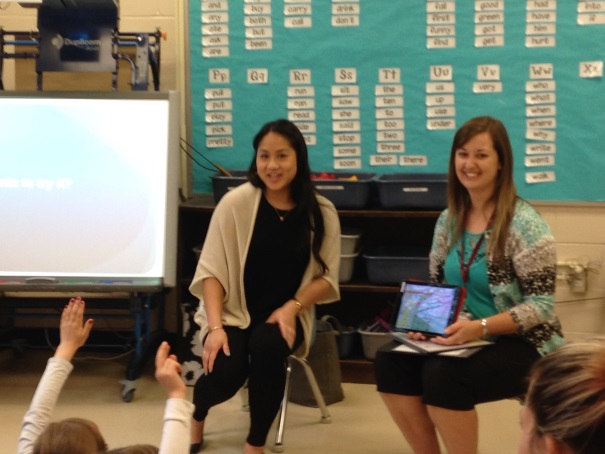
Lili has been an incredible advocate for her daughter and the world of AAC, leading presentations to Ava's class yearly to share the strategies she has learned and to answer questions students have about Ava's communication.  As part of Autism Awareness Month this past April, Lili gave 8 presentations to students at St Jude's Catholic School in Ingersoll from Kindergarten to Grade 8! She created a presentation to highlight what AAC is and how it relates to Autism Spectrum Disorders, as well as to her daughter and other students who are non-verbal use symbols to communicate. As she presented from class to class, students of all ages were able to try using low-tech or high-tech communication systems to communicate without using their voices to see what it is like and to ask any questions they had.  She also shared how they can "be a great friend" - how to talk with and to support a student who uses AAC.  Through Lili's leadership, the community of St Jude's is leading the way in creating an inclusive environment where students who are non-verbal and their peers can support each other in their play, conversation and academics.  Way to go, Lili!!!


Introducing the stars on Matt's team!
Tracy Herman (classroom teacher), Jenn Wylie (ECE), Meghan McGrath (Educational Assistant), Tammy Keill (Educational Assistant) and Lisa Coville (Resource Teacher) are Matt's team at St Peter's and St Paul's Elementary School in Durham.  Matt is so lucky to work with a team that really understands the importance of communication in his life. They know that it takes time but it is worth the effort.   

Matt is using an iPad with LAMP communication software. Check out this video of one of Matt’s superstar team members helping him to read a book using his device! The team included Matt using his iPad as a goal on his IEP to ensure consistency in supporting his literacy and face to face communication. Learning and understanding LAMP is not a simple task but the team dedicated time and effort to learn the necessary skills to support Matt. None of this would have been possible without the support of the school administration that provides time for the team to meet with the ACS clinician to discuss progress and to receive training and consultation for next steps. 


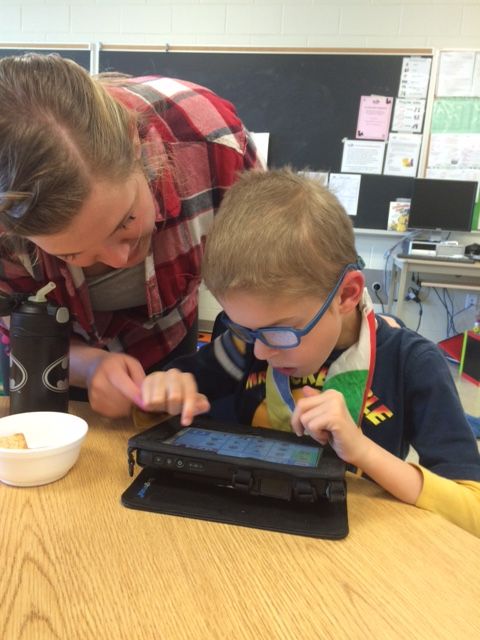
Even Matt's peers are in on the action.....see one of them here, playing with Matt and helping him to use his iPad!  Thanks team for your dedication and for your great work!!


And here's Mac's team!!! Mac attends Hollands Chatsworth Central School in Chatsworth. She is a wonderful girl who works very hard to communicate with others using symbols, signs and an iPad mini with Proloquo2Go. She carries her device with her  everywhere and even though she cannot hear, she has learned to use her message window so well that she is able to correct the message as she needs to before delivering it.Ruth Turner is her EA and she goes above and beyond when working with Mac. Thank you Ruth, you rock!!!

Here you can check out a video of Mac in action at school!!!  She has come a long way with the extraordinary support of her school team. 


Now Leigha and her team!!!
Leigha attends Senior Kindergarten at McGregor Public School in Aylmer. She has been using a Flip 'n Talk at home and at school. Leigha's mom Shelley and Leigha's EA Jillian updated the vocabulary so that it's significant to Leigha. Their hard work and attention to detail has paid off - Leigha's Flip 'n Talk looks amazing!

At school, Jillian is taking lots of opportunities throughout the day to provide Leigha with Aided Language Stimulation or Modeling. This strategy has been shown to help children develop language and expand their vocabulary. Jillian is doing a fantastic job! She models relevant vocabulary during journal. She models core words and food items during snack and lunchtime. She models colours and clothing during play time. She models relevant vocabulary while Leigha plays on the iPad. She also models relevant vocabulary during circle time. Jillian even encourages Leigha's peers to model vocabulary during play time! Leigha's peers have been very interested in helping her use symbols since we completed our AAC Awareness Presentation. They're doing a great job supporting her in the classroom as well!  Way to go everyone! Keep up the great work!


Introducing Royce and his amazing team!!!
Royce attends Southwold Public School. He recently received a device and his school team has been dedicated to teaching him a complex vocabulary system. Royce is learning to use Minspeak which is a tricky AAC language to learn. Royce's EAs Michelle and Jen went above and beyond and created flashcards for core words and other commonly used words so that Royce could learn how they were represented within Minspeak. Each flashcard has a word written on one side and the sequence of symbols that need to be selected to say that word on the other. What a great way to support Royce's learning! Fantastic job!


Way to go - Jamie's team!!!!
We would like to thank Jamie’s team for all their commitment and hard work to be sure he learns to use his communication device. Jamie uses an iPad with Proloquo2Go and he has become very efficient with it. Jamie is not just able to let everybody knows his wants and needs, he can also answer questions and have a nice chat. Jamie is a very communicative young man with great sense of humor. Having a way to communicate is a key factor when we talk about integration. His team has the great ability to take the best of him and turn it into a very pleasant experience.

Jamie attends West Hill Secondary School in Owen Sound.
In this picture we can see his school team. From left to right in the back we have Sue Kitto, Peter Stewart, Liz Drimmie, Shelley McCollum and Jessica Umar. In the front are Jamie and Kaitlyn Crone.  Thank you to you all!!! You are AWESOME!!

A special thanks goes out to the TVCC ACS clinicians and the teams here for sharing their stories!!!


.